Monday, October 13, 2014

Public Memory Is Short-Lived. Is It Good Or Bad?


Public memory is short-lived. Is it good or bad? We will discuss about this Point-Blank in detail.

Angered people chopped off the male part of a middle-aged man in Mumbai after he was caught for sexually assaulting a six-year-old girl in his neighbourhood.
Muskan
Mohanakrishnan, one of the accused in rape and murder of a 10-year-old girl Muskan Jain and murdering her brother Hritik Jain, on October 29, 2010. Mohanakrishnan was shot dead by the police when he tried to escape from their custody after attacking the policemen on November 9, 2010.
Former chief minister J Jayalalithaa, her aide N Sasikala, Sasikala’s relative J Elavarasi, Jayalalithaa’s foster son V N Sudhakaran were slapped for amassing wealth disproportionate to their known sources of income in 1996.
One of the leading counselors in the city Preethi Manohar, BA (Psy) PG DIP. IN Guidance & Counseling in Department of Guidance & Counseling in Sooriya Hospital, Vadapalani, says, “This is very much true. Whenever any incident happened, for example, a brutal rape, we (people) normally think emotionally. We never relate the issue or think rationally.”
When the bodies of the young siblings Muskan and Hritik were fished out of PAP canal in Pollachi two days after the kids went missing on October 29, 2010, the people were emotional and fiery in their words. Measuring the wavelength of the people, a police team killed one of the accused Mohanakrishnan when he tried to escape from the police custody 10 days later. People appreciated and welcomed the stringent act taken by the cops.
Mohanakrishnan’s aide R Manoharan has been awarded with double death sentence in 2012 and it was confirmed by the Madras high court in 2014. People are now thinking rationally over a period of time and, seeing the accused crying profusely to the media people that he was innocent, people are preparing their mind to rethink the final verdict awarded to him.
Taking the views of Muskan and her family, relatives, they are still mourning for the death of their children. They would have certainly shed tears for letting off the accused from the noose. But it is true, the peoples mindset have been changing.
Preethi Manohar says: “People think rationally after consuming time. It can also say in other way time is inversely proportional to the perception. Once time starts moving on, the perception over some issue will also be diluted in due course.”
Though the angered people chopped off the male part of the rapist in public, they may rethink their view once the time starts rolling on further and further. The sensational disproportionate assets case is another fine example for it.
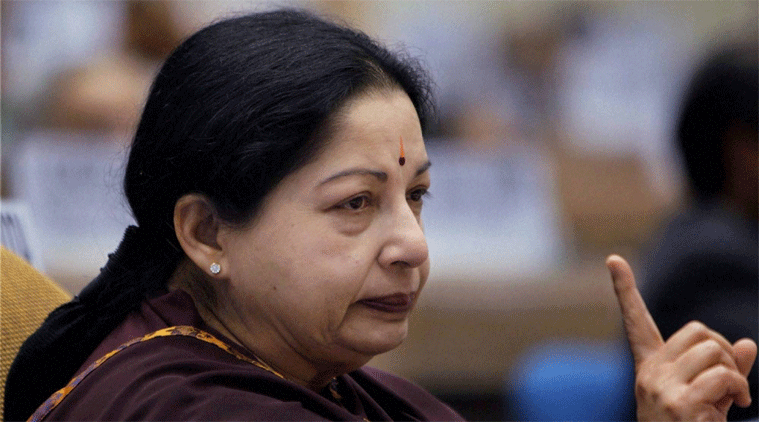
When the DMK government slapped the case on Jayalalithaa and three others for amassing wealth to Rs66 crore in 1996, the then DMK government displayed the rows of chappals, dresses and gold jewellery. People were shocked to see the wealth. Now it’s almost 18 years on. She was punished twice by the state people by keeping her away from the power since 1996. 
(In many upper class and upper middle-class homes now, many women have more than they had displayed at Jayalalithaa’s residence in 1996)
People are started thinking she has already undergone her punishment by throwing her away from the power in 1996 and 2006 general assembly elections. The people who were all cursed Jayalalithaa once for amassing wealth, now they have made up their mind to pardon her. “It is true, many common people, working class, middle class and upper class people are feeling pity for imprisoning her in prison for an 18-year-old case.”
Another classic example is the assassination of former Prime Minister Rajiv Gandhi in Sriperumbudur in 1991. Several accused involved in the case were dead and four of the arrested accused have been in prison since 1991 onwards. Though people were stubborn to hang the people involved in the brutal murder of the leader of the Indian sub-continent, now there are difference of opinions in executing the death penalty. It’s again the people’s court is judging and writing the final judgment.
How is this working? No one knows and they is no rule for it. Time is the only medicine to heal all pains. That is the reason many politicians start showering their sudden-love towards the people towards the general assembly elections and parliamentary elections.
Counselors and psychologists have confirmed this is applicable to people across the world in the universe.

Also read –

More discussion soon…
With thanks.

Sunday, October 12, 2014

Smart People Think Similar – The Secret Key To Become ‘Super Power’ In The World

Smart People Think Similar – The Secret Key To Become ‘Super Power’ In The World

“Smart people think similar” - This phrase is termed for ‘learned’ people especially IIT-ians and people studying in top level educational institutions.
Why we are calling them so? Though they are different in their religion, community, caste etc…They unite in their ideas and views. But most of the people differ in their religion, community, caste and also differ in all their views and opinions.
Another interesting point, I want to emphasize is the ‘so called’ learned people often convince others (people), after analyzing it themselves applying pros and cons, to accept their views and ideas. In contrast to this, the people often convince to the views of others and never think about it, as most of them are lazy.
It can also be said, viewing in other angle, the learned people never allows the ordinary people to think and use their sixth sense. Several people don’t want to apply and use their mind to find out a solution for a question.
Casteism comes into existence since thousands of years before in India, which forces a sect of people to keep them always low among other human beings. Now, we have a tool called ‘democracy’. This helps several millions of people to quote as an excuse to avoid using their sixth sense. Indians often ignore and least care for the country’s development citing the freedoms of ‘blah-blah’. Indians are now customizing their minds for all excuses.
Banega Swachh India Campaign – announced by the Indian Prime Minister Narendra Modi. Several top leaders, union ministers and actors and their fans club are taking challenge to clean up ‘India’. This was earlier shown in a yester-year cum veteran actor MG Ramachandran’s movie. (Song: Theru Theruvai Kootuvadhu Podhu Nala Thondu…)  
The campaign will certainly become a success only if each and every citizen in our country starts the same campaign from themselves at their houses. Then only the ‘Banega Swachh India campaign’ will become a ‘revolution’.
Though the leaders of the political parties think unique and try to execute their ideas, the difference in thought diversify the ideas. Several laymen including an autorickshaw driver, bunk shop owner, private company staffs think entirely different and worse the campaign, many of them are not even aware of the campaign. We should take it serious. Why the campaign didn’t reach the grass roots of India? The answer is people don’t want to take up the ‘challenges’ as they give least priority to them.
Vellore Revolt and Sepoy Mutiny was suppressed by the British rulers before it spread all over the country in the early 1800s’, because of lack in media and television. Now everyone has mobile, television and all the gadgets, still the Banega Swachh India campaign does not reach the common people. People don’t think similar always.
What is their first priority? People think, basic amenities and cheaper commodities are their first priorities. The political party which is heading the country should also focus on to answer these questions, apart from utilizing ‘high profile’ people in the Banega Swachh India campaign.
United States of America (USA) is a group of countries and they always unite as America as a whole in spite of difference in all their opinions. India will represent the world only when all the people in the Indian sub-continent think alike. The people in the ‘United States of India’ should think alike to make India at least to qualify for the ‘super power in the world’.
More discussion soon…
With thanks.

Publishing And Telecasting Victim's Photograph In Conflict With Law

I want to insist in the Point Blank range about the media and newspapers publishing and telecasting the photographs of the victims in crime.

A senior police officer aired a grievance in publishing and telecasting the photographs of the victims in conflict with law.
Very recently, a middle-aged woman living alone at a rented house in Thatchur near Ponneri on Chennai-Kolkata National Highway was murdered by her husband. She had been living separate in the house and the woman was killed, suspecting her fidelity.
All the media and newspapers published the news with the picture of the deceased woman portraying her in bad picture. The officer reasoned, “How many of you are aware that the woman has a son studying in Class 11 and a daughter studying in a private college.”
The son and daughter are wearing helmet to walk on the road and streets in their village. Their mother has done something wrong and she is no more. Is it worth punishing her children and their close relatives by publishing the woman’s picture in the newspaper? What will be the fate of the youths career?
Recently, an evening daily newspaper and a leading morning daily have also ended in trouble by portraying a section of people as terrorists and defamed women. In both the incidents, both the newspapers have clarified their mistake. But, is it possible for them to compensate the damage caused by them by merely publishing the victims.
Most of the newspaper reporters do not aware of these facts and its implications. The reporters fight with each other to give exclusives and ignore the underlying problems.
Several newspapers are still ignorant in publishing children victimized in conflict with law and victims of sexual harassments. Many child right activists are condemning these act, the rule is being followed only in high profile cases. If the victim children are from poor background, no one bothers it.
It is time to realize this before penning down and publishing the photographs of the victims in conflict with law.
With Thanks.

Point Blank Range

Point Blank Range:

Point-blank range means, in external ballistics, point-blank range is the distance between a firearm and a target of a given size such that the bullet in flight is expected to strike the target without adjusting the elevation of the firearm.

The author of the blog A Selvaraj has tried to enlighten the issue, which we often rule out as a routine thing. Many issues, which we take it as a lighter way, are affecting them very hard and spoiling their future too.
The idea is to avoid these glitches to enlighten the victims directly and indirectly affected in conflict with law.
Thanks